
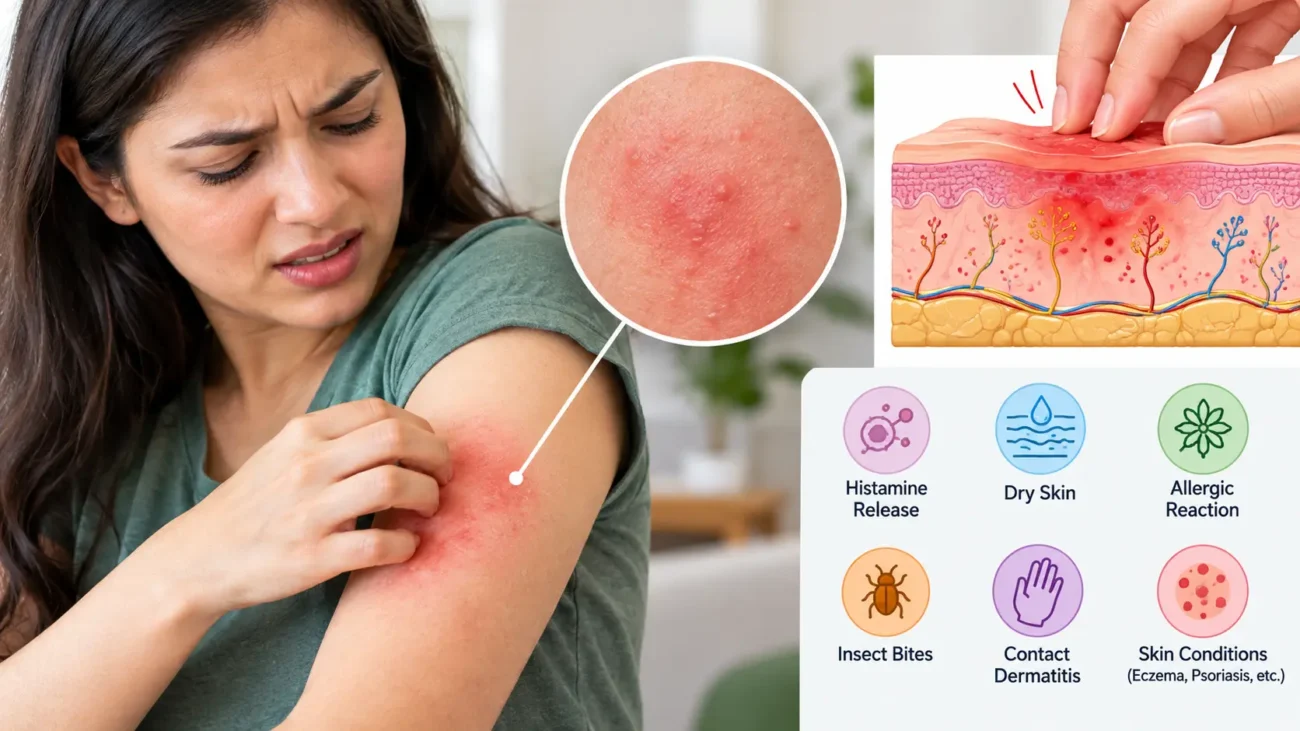
Ever wonder Why Does Skin Get Red and Itchy After Scratching? You scratch an itch, and for a second it feels great. Then a red mark shows up, and somehow your skin itches even more than before. That’s not bad luck. It’s a specific chain reaction happening right under your skin, and once you understand it, you can actually stop feeding it.
Quick Answer
Scratching irritates nerve endings and skin cells, which release a chemical called histamine. Histamine widens blood vessels and triggers swelling, which is why the area turns red, puffs up, and itches harder. The more you scratch, the more histamine gets released, so relief is always temporary.
What Happens Under Your Skin When You Scratch?
Your skin contains thousands of touch receptors. These touch receptors are nerve endings called C-fibers. The C-fibers react to irritants such as dry skin, insect bites, sweating, and wool clothing. Touch receptors are what make you feel the prickle of an itch. When you scratch an itch, you get a different, pleasant sensation that overpowers the itch, but only for a moment.
Nerve Endings Fire First
The instant you scratch, pressure and friction activate even more nerve endings in that patch of skin. Your brain registers this as minor trauma, not comfort, and starts the body’s repair-and-defend response.
Histamine Causes the Redness
Mast cells located just below the surface of the skin release one of the main inflammatory chemicals called histamine when they are stimulated. The latter causes dilation of the capillaries, allowing more blood to flow through the affected part. As a result, the area around the scratch tends to become red, warm, and slightly swollen.
Why Does My Skin Get Red and Itchy After Scratching?
In short: your skin and brain are stuck in a loop called the itch-scratch cycle. Scratching damages the outer skin barrier just enough to let more histamine out and more irritants in, which creates a new itch signal before the old one has even faded.
The Itch-Scratch Cycle, Step by Step
- You feel an itch from dryness, irritation, or a bite.
- You scratch, and a pain signal briefly blocks the itch in your brain.
- Scratching damages skin cells and releases histamine.
- Histamine widens blood vessels, causing redness and swelling.
- The irritated nerve endings send a fresh itch signal.
- You scratch again, and the cycle repeats, often leaving the area more inflamed each time.
This is also why an itch seems to spread. Scratching around the original spot irritates nearby nerve endings too, so the itchy area can grow larger the longer you scratch.
Is This Normal, or Could It Be Dermatographia?
A little redness after a light scratch is completely normal. But if your skin consistently raises into welts shaped exactly like the scratch mark, you may have a harmless, common condition called dermatographia, sometimes called “skin writing.” The table below shows how to tell reactions apart.
| Reaction | What It Looks Like | How Long It Lasts |
| Normal scratch response | Light pink or red streak, mild swelling | Fades in 10-20 minutes |
| Dermatographia (skin writing) | Raised, red welts shaped like the scratch | 30 minutes, sometimes hours |
| Allergic hives (urticaria) | Puffy welts that can spread beyond the scratch | Hours to a couple of days |
| Eczema flare-up | Dry, cracked, darker or red patches | Days to weeks without treatment |
Common Triggers That Make Skin React This Way
- Dry or dehydrated skin, especially in winter or after hot showers
- Tight clothing, wool fabric, or rough towel-drying
- Insect bites, allergic reactions, or new skincare products
- Eczema, psoriasis, or other existing skin conditions
- Stress, which can make nerve endings more sensitive to itch
Simple Ways to Calm Red, Itchy Skin
You don’t need anything fancy to break the cycle. Start with the least irritating option and work up only if needed.
- Press a cool, damp cloth on the area instead of scratching it.
- Apply a fragrance-free moisturizer right after washing, while skin is still damp.
- Try an over-the-counter antihistamine if the itch is widespread or allergy-related.
- Keep fingernails short and consider thin gloves at night if you scratch in your sleep.
- Switch to lukewarm, not hot, showers and a mild, fragrance-free soap.
When to See a Doctor
Usually, the rash goes away independently in 20-30 minutes or later after rubbing. If the rash persists for more than two weeks, affects much of the skin, appears with yellow crusted patches, or occurs with fatigue and weight loss or other intercurrent symptoms unrelated to the skin, it should be evaluated by a physician or dermatologist; this might indicate an allergic reaction, an infection, or another condition requiring specific treatment.
Frequently Asked Questions
Why does scratching make an itch worse instead of better?
Scratching only blocks the itch signal for a few seconds. Underneath, it releases more histamine and irritates more nerve endings, so the itch typically comes back stronger within minutes.
Is it bad to scratch an itch until it bleeds?
Yes. Breaking the skin raises your risk of infection and can leave scars or darker marks that take weeks to fade, even after the original itch is long gone.
Why do red marks from scratching look like raised lines?
Raised, line-shaped welts that follow the exact path of your fingernail are the classic sign of dermatographia, a common and generally harmless skin reaction to pressure.
Can stress make my skin itchier after scratching?
Yes. Stress hormones can make nerve endings more reactive, which is why itching often feels worse during stressful periods, even when skin looks the same as usual.
How long should redness from scratching last?
A typical scratch mark fades within 10 to 30 minutes. If redness or swelling lasts for hours or returns daily, it’s worth having a doctor take a look.
What stops the itch-scratch cycle fastest?
Cooling the skin and applying a fragrance-free moisturizer works faster than most people expect, because it calms irritated nerve endings without adding the friction that scratching does.
The Bottom Line
Red, itchy skin after scratching is not a mystery or a sign of something terrible happening. Usually, histamines and irritated nerve endings are just doing their job. It’s best to stop the itching as soon as possible by using a cold cloth, some cream, and short nails to get rid of a rash more quickly than continued scratching will ever allow.