
Introduction
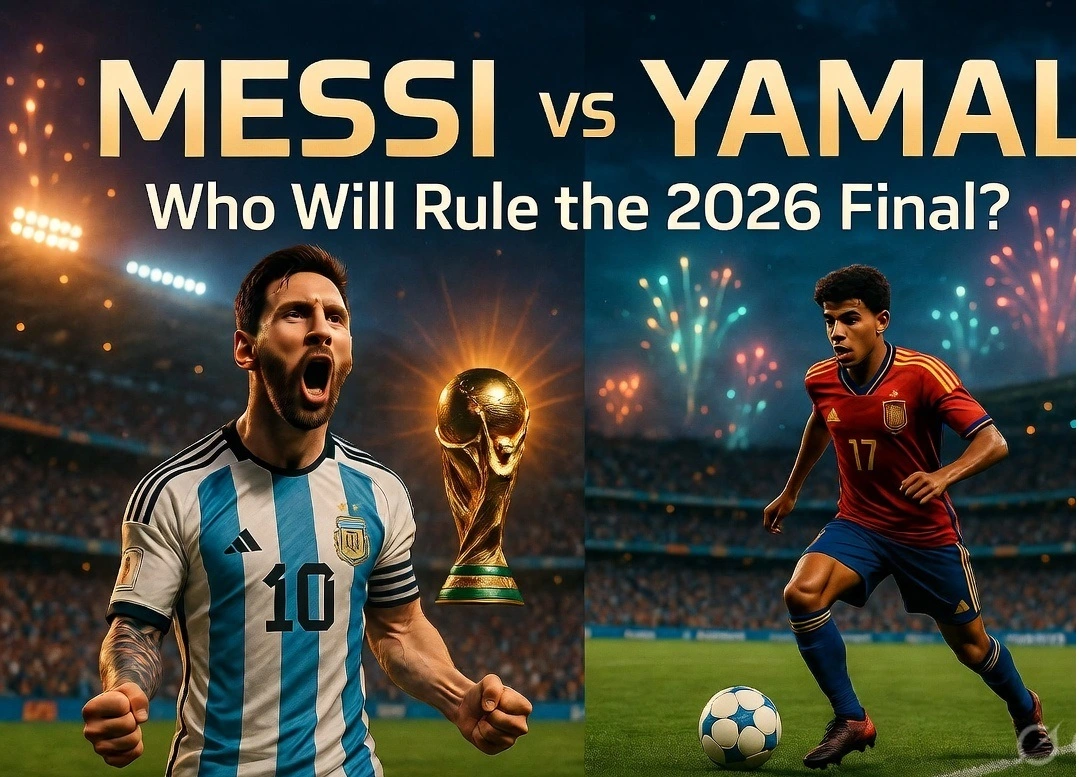
The ultimate generational clash is finally here as Messi vs Yamal takes center stage in the World Cup 2026 final. While the world prepares to watch the legendary master face football’s brightest young prodigy at MetLife Stadium, there is a much deeper story behind this historic matchup than meets the eye.
I am a football guy,at least that’s what my browser history says. That’s what my 2 a.m. tab count suggests during any given tournament. That’s the box most people who know me would put me in without thinking twice. But here’s the thing about boxes — they’re accurate until they’re not. Because when I’m not refreshing lineup news, I’m reading about the economics of a 48-team World Cup. Or the mechanics of Yamal’s first touch. Or why a 39-year-old man playing two-thirds of a semi-final at walking pace can still decide it. Or what it means that a kid who was photographed as a baby in Messi’s arms is now standing across from him in a final. I watch everything. Hungrily, messily, without a system. And for a while now, I’ve been writing about it too. Quietly. Alone. The way most people write when they’re not sure if anyone’s still awake to read it.
I’ve also been reading a lot of what passes for World Cup analysis on the internet this week. And I’ll be honest with you: most of it wants to make this simple. Old king versus young pretender. Sunset versus sunrise. Content that fits in a thumbnail. But I watched both semifinals, and neither man read the script.
How Spain and Argentina Reached the MetLife Stadium
Here’s what actually happened, in case you spent Tuesday and Wednesday living a life instead of watching football, which I don’t recommend but understand. Spain beat France 2-0 in Dallas, a performance so controlled it barely counted as drama — Mikel Oyarzabal and Pedro Porro did the scoring, but Lamine Yamal did the unsettling, drawing fouls, drawing a penalty shout, and drawing France’s entire back line two yards out of position just by existing near the ball. He didn’t get on the scoresheet that night the way some reports suggest he did earlier in the tournament against France; he was, instead, the reason the game never had a second act for Les Bleus. Then a day later in Atlanta, Argentina and England played what one writer accurately called a street brawl that turned into ballet with chainsaws, and Messi – who didn’t score, who barely needed to run – laid on both goals in the dying minutes, the second a cross so precise it embarrassed the concept of a 39-year-old body. Argentina came from behind. Again. They’ve built an entire World Cup out of doing that.
So now it’s Sunday. MetLife Stadium, New Jersey. Spain versus Argentina, a Finalissima the calendar owed us from last year and finally decided to pay out on the biggest stage there is.
The Story Behind the Famous Bath-Time Photo
And the sentence everyone’s writing, the one I’m apparently contractually obliged to write too: Messi first met Yamal as a baby, in a charity calendar photo from December 2007, Messi mid-bath-time with a six-month-old who would grow up to wear Barcelona’s number 10 and, this Sunday, try to end his childhood photographer’s second act as a champion.
I don’t think that photo means what the highlight packages want it to mean. It’s not a torch being passed. Torches get passed when someone retires. Messi has 21 World Cup goals, the most anyone’s ever scored across tournaments, and he is one win away from doing something no player has managed since Brazil in 1958 and 1962 — winning back-to-back World Cups. He is tied with Kylian Mbappé for this tournament’s Golden Boot lead on eight goals, and he’s recorded a goal or an assist in eleven straight World Cup matches, a streak that goes back to 2022 and doesn’t belong to anyone else alive. A man doesn’t do that by fading gracefully into metaphor. He does it by still being the most dangerous person on the pitch even when his sprint speed has quietly retired before he has.
And Yamal isn’t a torch-bearer either, not really — he’s just early. He turned 19 the day before the semifinal, which means he has spent this entire World Cup being the youngest important person in every room he’s walked into, including, at various points, rooms full of French internationals who could not physically dissuade him from doing what he wanted with the ball. An injury before the tournament dulled his group stage, and the goal tally by the time he reached the final was modest — one, against France, the finish that mattered more than the count suggests, plus a body of work that had grown men drawing penalties on him rather than the other way around. He’s started a World Cup semifinal at an age when most of his generation are still deciding on a university course. Whatever this final does to him, it will not be the ceiling. It’ll be the floor.
Who Rules the World Cup 2026 Final?
So who rules Sunday? I think the honest answer, the one that won’t get clicks but will get you through the actual 90 minutes with your expectations intact, is that it depends which version of “ruling” you mean. If ruling means the man the trophy remembers, Messi has the tournament, the history, and a supporting cast — Lautaro Martínez, Enzo Fernández, Julián Álvarez — that has bailed Argentina out of trouble in almost every knockout round so far, which tells you something about a team built to survive its own chaos. If ruling means the player who makes you sit up in your chair, who turns a back four inside out on instinct rather than memory, that’s been Yamal’s whole tournament, injury and all, and Spain’s unbeaten run through ten straight World Cup knockout games says the system around him is finally as good as he is.
A Tactical Clash of Styles (Not a Personal Duel)
I keep coming back to the fact that this isn’t really a duel. Messi plays as a forward who drops deep to conduct; Yamal plays as a wide forward who cuts inside to detonate. They will spend most of Sunday not marking each other, not directly opposing each other, just existing on the same 8,000-square-meter rectangle while two genuinely excellent teams try to solve two genuinely different puzzles. Argentina will try to make the game ugly and specific, the way they did against England, and dare Spain to get frustrated. Spain will try to keep the ball so long that ugliness becomes irrelevant, the way they did against France. Somewhere in the middle of that argument, an old man and a teenager will both try to be the reason their side wins, and only one of them gets to be right.
If you’d asked me a decade ago whether football could still produce a storyline this clean — the greatest ever, one door away from an ending only a handful of teams in a century have written, across from the kid who was a baby in his arms — I’d have told you sports don’t usually hand you symbolism this obvious. They usually make you work for it. This time it just showed up on the schedule, like it always intended to.
I don’t know who wins. I’m not going to pretend the numbers tell you that, because they don’t — Messi’s history says one thing, Spain’s form says another, and football has spent this entire tournament ignoring what either of those things predicted. What I do know is that Sunday isn’t really Messi versus Yamal. It’s Messi’s whole career, one final time, against everything Yamal’s is about to become. And I’ll be up at 3 p.m. Eastern watching both clocks run at once, same as everyone else who can’t put the sport in a box either.
